Description
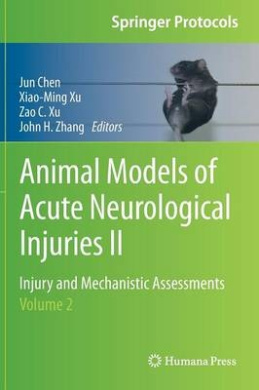
The successful previous volume on this topic provided a detailed benchwork manual for the most commonly used animal models of acute neurological injuries including cerebral ischemia, hemorrhage, vasospasm, and traumatic brain and spinal cord injuries. Animal Models of Acute Neurological Injuries II: Injury and Mechanistic Assessments aims to collect chapters on assessing these disorders from cells and molecules to behavior and imaging. These comprehensive assessments are the key for understanding disease mechanisms as well as developing novel therapeutic strategies to ameliorate or even prevent damages to the nervous system. Volume 2 examines global cerebral ischemia, focal cerebral ischemia, and neonatal hypoxia-ischemia, as well as intensive sections covering traumatic brain injury and spinal cord injury. Designed to provide both expert guidance and step-by-step procedures, chapters serve to increase understanding in what, why, when, where, and how a particular assessment is used. Accessible and essential, Animal Models of Acute Neurological Injuries II: Injury and Mechanistic Assessments will be useful for trainees or beginners in their assessments of acute neurological injuries, for experienced scientists from other research fields who are interested in either switching fields or exploring new opportunities, and for established scientists within the field who wish to employ new assessments. 1. Introduction (Parts I-III) R. Anne Stetler and Miguel A. Perez-Pinzon Part I: Global Cerebral Ischemia (GCI) 2. Morphological Assessments of Global Cerebral Ischemia: Viable Cells Peiying Li 3. Morphological Assessments of Global Cerebral Ischemia: Degenerated Cells Peiying Li 4. Morphological Assessments of Global Cerebral Ischemia: Electron Microscopy Irina S. Balan, Tibor Kristian, Chunli Liu, Andrew J. Saladino, and Bingren Hu 5. Biochemical and Molecular Biological Assessments of Global Cerebral Ischemia: mRNA R. Anne Stetler and Yu Gan 6. Biochemical and Molecular Biological Assessments of Global Cerebral Ischemia: Protein Yu Gan and R. Anne Stetler 7. Neurobehavioral Assessments of Global Cerebral Ischemia Pinar Kendigelen, Dandan Sun, and Pelin Cengiz 8. Assessment of Neurogenesis in the Dentate Gyrus after Global or Focal Ischemia Wei Liu and Jialing Liu Part II: Focal Cerebral Ischemia (FCI) 9. Infarct Measurement in Focal Cerebral Ischemia: TTC Staining Feng Zhang and Jun Chen 10. Morphological Assessments of Focal Cerebral Ischemia: White Matter Injury Feng Zhang and Lyanne C. Schlichter 11. Blood Flow Reduction: Laser Doppler, 14C-IAP Feng Zhang, Steven H. Graham, and Jun Chen 12. Biochemical and Molecular Biological Assessments of Focal Cerebral Ischemia: mRNA and MicroRNA Yu Gan and R. Anne Stetler 13. Biochemical and Molecular Biological Assessments of Focal Cerebral Ischemia: Protein R. Anne Stetler and Yu Gan 14. Assessments of Inflammation After Focal Cerebral Ischemia Xiaoming Hu and Jun Chen 15. Neurobehavioral Assessments of Focal Cerebral Ischemia: Sensorimotor Deficit Yejie Shi and Dandan Sun 16. Neurobehavioral Assessments of Focal Cerebral Ischemia: Cognitive Deficit Yejie Shi and Dandan Sun 17. Assessment of Neurogenesis in Models of Focal Cerebral Ischemia Feng-Yan Sun, Xiao Sun, Ji-Jiang Wang, Qiu-Wan Zhang, and Yong-Quan Wang 18. Assessment of Angiogenesis in Models of Focal Cerebral Ischemia Hong Shi, Yanqin Gao, and Weimin Liang Part III: Neonatal Hypoxia-Ischemia (NHI) 19. Morphological Assessments of Neonatal Hypoxia-Ischemia: In Situ Cell Degeneration Changlian Zhu and Klas Blomgren 20. Morphological Assessments of Neonatal Hypoxia-Ischemia: White Matter Injury Dianer Yang and Chia-Yi Kuan 21. Biochemical and Molecular Biological Assessments of Neonatal Hypoxia-Ischemia: Cell Signaling Changlian Zhu and Klas Blomgren 22. Biochemical and Molecular Biological Assessments of Neonatal Hypoxia-Ischemia: Inflammation Xiaoming Hu and Jun Chen 23. Neurobehavioral Assessments of Neonatal Hypoxia-Ischemia Masanori Iwai and Jun Chen 24. Assessment of Neurogenesis and White Matter Regeneration Masanori Iwai, Hiroko Tajiri, Shiro Matsumoto, Hiroshi Mitsubuch, and Fumio Endo Part IV: Traumatic Brain Injury (TBI) 25. Assessments for Traumatic Brain Injury: An Introduction Kathryn E. Saatman 26. Morphological Assessments of Traumatic Brain Injury Daniel van Bregt, Theresa Currier Thomas, Rachel D. Rowe, and Jonathan Lifshitz 27. Assessment of Cerebral Vascular Dysfunction after Traumatic Brain Injury Douglas S. DeWitt and Donald S. Prough 28. Assessment of Membrane Permeability After Traumatic Brain Injury Michelle C. LaPlaca and Marcus Chris Lessing 29. Assessment of Neurogenesis by BrdU Labeling After Traumatic Brain Injury Jinhui Chen and Xiang Gao 30. Electrophysiological Approaches in Traumatic Brain Injury Thomas M. Reeves and Beverly S. Colley 31. Biochemical and Molecular Biological Assessments of Traumatic Brain Injury Coleen M. Atkins and Anthony Andrew Oliva, Jr. 32. Assessments of Oxidative Damage and Lipid Peroxidation after Traumatic Brain Injury and Spinal Cord Injury Jeffrey M. Bosken, Juan A. Wang, and Edward D. Hall 33. Neurobehavioral Assessments of Traumatic Brain Injury James W. Bales, Kristin Macfarlane, and C. Edward Dixon 34. Vestibular Assessments Following Traumatic Brain Injury James W. Bales, Kristin Macfarlane, and C. Edward Dixon Part V: Spinal Cord Injury (SCI) 35. Introduction on Assessments for Spinal Cord Injury Theo Hagg 36. Morphological Assessments Following Spinal Cord Injury Chandler L. Walker and Xiao-Ming Xu 37. Assessment of Lesion and Tissue Sparing Volumes Following Spinal Cord Injury Lyn B. Jakeman 38. Retrograde Axonal Tract Tracing Lingxiao Deng, Xiaofei Wang, Chandler L. Walker, Yiwen Ruan, and Xiao-Ming Xu 39. Anterograde Axonal Tract Tracing Xiaofei Wang, Lingxiao Deng, and Xiao-Ming Xu 40. Assessments of Gliogenesis After Spinal Cord Injury Drew L. Sellers and Philip J. Horner 41. Assessing Microvessels After Spinal Cord Injury Theo Hagg, Richard L. Benton, Janelle M. Fassbender, and Scott R. Whittemore 42. Physiological Assessment of Spinal Cord Injury Lisa B.E. Shields, Yi Ping Zhang, and Christopher B. Shields 43. Electrophysiological Assessment of Spinal Cord Function on Rodents Using tcMMEP and SSEP Yi Ping Zhang, Lisa B.E. Shields, and Christopher B. Shields 44. Operant Conditioning of Spinal Cord Reflexes in Rats Xiang Yang Chen and Jonathan R. Wolpaw 45. Cellular and Molecular Biological Assessments of Inflammation and Autoimmunity After Spinal Cord Injury Yi Zhang, Daniel P. Ankeny, and Phillip G. Popovich 46. Neurobehavioral Assessments of Spinal Cord Injury Jed S. Shumsky and John D. Houl 47. Basso, Beattie, and Bresnahan (BBB) Scale Locomotor Assessment Following Spinal Cord Injury and Its Utility as a Criterion for Other Assessments Darlene A. Burke and David S.K. Magnuson 48. High Speed Video Recording Used for the Analysis of Hand Shaping in Over Ground Walking, Cylinder Exploration, Skilled Reaching, and Rung Walking in Rats Ian Q. Whishaw and Lori-Ann Sacrey 49. Automated Gait Analysis Following Spinal Cord Injury Jason E. Beare, Johnny R. Morehouse, David S.K. Magnuson, and Scott R. Whittemore 50. Forelimb Functional Assessments of Rats and Mice After Cervical Spinal Cord Injury Stephen M. Onifer 51. Swimming as an Assessment of Hindlimb Function in Animals with Traumatic Spinal Cord Injury Edward H. Brown, Johnny R. Morehouse, and David S.K. Magnuson 52. Neuroimaging Assessment of Spinal Cord Injury in Rodents Mehmet Bilgen