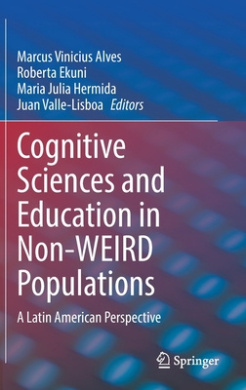
Description
Part I – Cognitive Sciences and Education: Theories, Beliefs and Misconceptions 1. The importance of bringing the Latin American perspective to cognitive science and education 2. Neuroscience and Vygotsky: putting together contemporary evidence and Cultural-Historical Psychology. 3. Dialogue with Latin American teachers – beliefs about neuroscience and education Part II – Factors influencing child and adolescent development 4. Attention and academic performance: from early childhood to adolescence. 5. Child cognitive development in Latin American rural poverty: what do researchers should consider for conducting fieldwork 6. Concepts, language, and early socialization in indigenous Wichi perspective: towards a Relational-Ecological Paradigm 7. The role of local violence on children’s affective decision-making 8. The role of peer pressure in adolescents’ risky behaviors 9. The implications of exposure to neurotoxic metals for cognitive development of children and adolescents Part III – Academic performance 10. Bilingualism, foreign language learning, and cognition: Insights for education 11. Development of mathematical cognition: the role of technology in low SES populations 12. Number processing and low arithmetic achievement in Cuban and Chilean children: from neurocognitive theories to educational practice 13. The perfect hurricane in Latin America: school start time, chronotype, sleep, and academic performance during adolescence 14. Stereotype threat and professional motivation: Assessing career expectations of undergraduate and graduate female students Part IV – Educational practices and interventions 15. Retrieval practice as a learning strategy for diverse populations 16. Consideration of individual differences in cognitive interventions for children at risk for poverty 17. Technology on our side: using technology for transferring Cognitive Science to Education 18. Early language intervention in school settings: what works for whom? 19. Developing higher order thinking in elementary school science: A narrative around a research group quest Part V – Future perspectives 20. Latin American perspectives in the study of childhood and adolescence poverty through the lenses of neural sciences