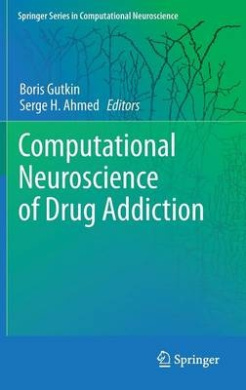
Description
Drug addiction remains one of the most important public health problems in western societies and is a rising concern for developing nations. Over the past 3 decades, experimental research on the neurobiology and psychology of drug addiction has generated a torrent of exciting data, from the molecular up to the behavioral levels. As a result, a new and pressing challenge for addiction research is to formulate a synthetic theoretical framework that goes well beyond mere scientific eclectism to deepen our understanding of drug addiction and to foster our capacity to prevent and to cure drug addiction. Intrigued by the apparent irrational behavior of drug addicts, researchers from a wide range of scientific disciplines have formulated a plethora of theoretical schemes over the years to understand addiction. However, most of these theories and models are qualitative in nature and are formulated using terms that are often ill-defined. As a result, the empirical validity of these models has been difficult to test rigorously, which has served to generate more controversy than clarity. In this context, as in other scientific fields, mathematical and computational modeling should contribute to the development of more testable and rigorous models of addiction. Foreword: P Dayan Part 1 – Pharmacological-based models of addiction Chapter 1. Simple deterministic mathematical Model of maintained drug delf-Administration behavior and its pharmacological applications. V.L. Tsibulsky* and A.B. Norman Chapter 2. Intermittent Adaptation : A mathematical model of drug tolerance, dependence and addiction. A. Peper Chapter 3. Control theory and addictive behavior. D. Newlin, P.A. Regalia, T.I. Seidman, G. Bobashev Part 2 – Neurocomputational models of addiction Chapter 4. Circuit models of addiction: receptors and neural dynamics in nicotine self-administration. M. Graupner and B. Gutkin Chapter 5. N Dual-system learning models and drugs of abuse. N.D. Daw and D.A. Simon. Chapter 6. Modeling decision-making systems in addiction Z. Kurth-Nelson and A. D. Redish Chapter 7. Computational models of incentive-sensitization in addiction: Dynamic limbic transformation of learning into motivation J. Zhang, K. C. Berridge, and J. W. Aldridge Chapter 8. Understanding addiction as a pathological state of multiple decision making processes: a neurocomputational perspective. M. Keramati, A. Dezfouli and P. Piray Part 3 – Economic-based models of addiction Chapter 9. Policies and priors K Friston Chapter 10. Toward a Computationally Unified Behavioral-Economic Model of Addiction E.T. Mueller, L.P. Carter and W.K. Bickel Chapter 11. Simulating Patterns of Heroin Addiction within the Social Context of a Local Heroin Market L. Hoffer, G. Bobashev and R. J Morris Chapter 10. Toward a Computationally Unified Behavioral-Economic Model of Addiction E.T. Mueller, L.P. Carter and W.K. Bickel Chapter 11. Simulating Patterns of Heroin Addiction within the Social Context of a Local Heroin Market L. Hoffer, G. Bobashev and R. J Morris