Description
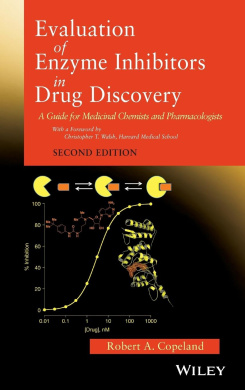
With enzymes being the most valued and common of drug targets, an understanding of their interactions with inhibitors is critical to successful drug discovery. Now in a second edition, this proven work clearly explains the biochemical data and experimental details underlying the science, arming medicinal chemists and pharmacologists with the tools they need to master the art of applied enzymology for drug discovery. With updated material throughout, two new chapters, and five new appendices, Evaluation of Enzyme Inhibitors in Drug Discovery, Second Edition remains the only book available on the topic. ROBERT A. COPELAND, PhD, is Executive Vice President and Chief Scientific Officer at Epizyme, Inc., a biopharmaceutical company in Cambridge, Massachusetts. He is on the Editorial Board of The Journal of Biological Chemistry and a member of the Faculty of 1000. Dr. Copeland has contributed more than 175 publications to the scientific literature and holds eight U.S.-issued patents. He has authored several books in protein science and enzymology, including Enzymes: A Practical Introduction to Structure, Mechanism, and Data Analysis, Second Edition (Wiley). FOREWORD TO SECOND EDITION BY CHRISTOPHER T. WALSH xvii PREFACE TO SECOND EDITION xix FOREWORD TO FIRST EDITION BY PAUL S. ANDERSON xxiii PREFACE TO FIRST EDITION xxv ACKNOWLEDGMENTS FROM FIRST EDITION xxix 1. WHY ENZYMES AS DRUG TARGETS? 1 Key Learning Points / 1 1.1 Enzymes Are Essential for Life / 2 1.2 Enzyme Structure and Catalysis / 6 1.3 Permutations of Enzyme Structure During Catalysis / 12 1.4 Extension to Other Target Classes / 17 1.5 Other Reasons for Studying Enzymes / 18 1.6 Summary / 21 References / 22 2. ENZYME REACTION MECHANISMS 25 Key Learning Points / 25 2.1 Initial Binding of Substrate / 25 2.2 Noncovalent Forces in Reversible Ligand Binding to Enzymes / 28 2.3 Transformations of the Bound Substrate / 30 2.4 Steady State Analysis of Enzyme Kinetics / 39 2.5 Typical Values of Steady State Kinetic Parameters / 46 2.6 Graphical Determination of kcat and KM / 47 2.7 Reactions Involving Multiple Substrates / 49 2.8 Summary / 54 References / 54 3. REVERSIBLE MODES OF INHIBITOR INTERACTIONS WITH ENZYMES 57 Key Learning Points / 57 3.1 Enzyme-Inhibitor Binding Equilibria / 58 3.2 Competitive Inhibition / 59 3.3 Noncompetitive Inhibition / 68 3.4 Uncompetitive Inhibition / 82 3.5 Inhibition Modality in Bisubstrate Reactions / 86 3.6 Value of Knowing Inhibitor Modality / 88 3.7 Enzyme Reactions on Macromolecular Substrates / 96 3.8 Summary / 118 References / 119 4. ASSAY CONSIDERATIONS FOR COMPOUND LIBRARY SCREENING 123 Key Learning Points / 123 4.1 Measures of Assay Performance / 125 4.2 Measuring Initial Velocity / 133 4.3 Balanced Assay Conditions / 142 4.4 Order of Reagent Addition / 146 4.5 Use of Natural Substrates and Enzymes / 148 4.6 Coupled Enzyme Assays / 154 4.7 Hit Validation / 156 4.8 Summary / 166 References / 166 5. LEAD OPTIMIZATION AND STRUCTURE-ACTIVITY RELATIONSHIPS FOR REVERSIBLE INHIBITORS 169 Key Learning Points / 169 5.1 Concentration-Response Plots and IC50 Determination / 170 5.2 Testing for Reversibility / 183 5.3 Determining Reversible Inhibition Modality and Dissociation Constant / 188 5.4 Comparing Relative Affinity / 190 5.5 Associating Cellular Effects with Target Enzyme Inhibition / 193 5.6 Summary / 200 References / 200 6. SLOW BINDING INHIBITORS 203 Key Learning Points / 203 6.1 Determining kobs: The Rate Constant for Onset of Inhibition / 205 6.2 Mechanisms of Slow Binding Inhibition / 207 6.3 Determination of Mechanism and Assessment of True Affi nity / 210 6.4 Determining Inhibition Modality for Slow Binding Inhibitors / 217 6.5 SAR for Slow Binding Inhibitors / 219 6.6 Some Examples of Pharmacologically Interesting Slow Binding Inhibitors / 220 6.7 Summary / 242 References / 243 7. TIGHT BINDING INHIBITION 245 Key Learning Points / 245 7.1 Effects of Tight Binding Inhibition on Concentration-Response Data / 246 7.2 The IC50 Value Depends on Ki app and [E]T / 248 7.3 Morrison’s Quadratic Equation for Fitting Concentration-Response Data for Tight Binding Inhibitors / 253 7.4 Determining Modality for Tight Binding Enzyme Inhibitors / 258 7.5 Tight Binding Inhibitors Often Display Slow Binding Behavior / 261 7.6 Practical Approaches to Overcoming the Tight Binding Limit in Determining Ki / 263 7.7 Enzyme-Reaction Intermediate Analogues as Examples of Tight Binding Inhibitors / 266 7.8 Potential Clinical Advantages of Tight Binding Inhibitors / 277 7.9 Determination of [E]T Using Tight Binding Inhibitors / 279 7.10 Summary / 282 References / 282 8. DRUG-TARGET RESIDENCE TIME 287 Key Learning Points / 287 8.1 Open and Closed Systems in Biology / 288 8.2 The Static View of Drug-Target Interactions / 292 8.3 Conformational Adaptation in Drug-Target Interactions / 294 8.4 Impact of Residence Time on Natural Receptor-Ligand Function / 300 8.5 Impact of Drug-Target Residence Time on Drug Action / 304 8.6 Experimental Measures of Drug-Target Residence Time / 318 8.7 Drug-Target Residence Time Structure-Activity Relationships / 325 8.8 Recent Applications of the Residence Time Concept / 334 8.9 Limitations of Drug-Target Residence Time / 338 8.10 Summary / 340 References / 341 9. IRREVERSIBLE ENZYME INACTIVATORS 345 Key Learning Points / 345 9.1 Kinetic Evaluation of Irreversible Enzyme Inactivators / 346 9.2 Affinity Labels / 350 9.3 Mechanism-Based Inactivators / 358 9.4 Use of Affi nity Labels as Mechanistic Tools / 375 9.5 Summary / 380 References / 380 10. QUANTITATIVE BIOCHEMISTRY IN THE PHARMACOLOGICAL EVALUATION OF DRUGS 383 Key Learning Points / 383 10.1 In Vitro ADMET Properties / 384 10.2 In Vivo Pharmacokinetic Studies / 426 10.3 Metabolite Identifi cation / 453 10.4 Measures of Target Occupancy / 454 10.5 Summary / 465 References / 466 APPENDIX 1 KINETICS OF BIOCHEMICAL REACTIONS 471 A1.1 The Law of Mass Action and Reaction Order / 471 A1.2 First-Order Reaction Kinetics / 475 A1.3 Second-Order Reaction Kinetics / 478 A1.4 Pseudo-First-Order Reaction Conditions / 479 A1.5 Approach to Equilibrium: An Example of the Kinetics of Reversible Reactions / 480 APPENDIX 2 DERIVATION OF THE ENZYME-LIGAND BINDING ISOTHERM EQUATION 483 APPENDIX 3 SERIAL DILUTION SCHEMES 487 APPENDIX 4 RELATIONSHIP BETWEEN [I ]/IC50 AND PERCENTAGE INHIBITION OF ENZYME ACTIVITY WHEN h = 1 491 APPENDIX 5 PROPAGATION OF UNCERTAINTIES IN EXPERIMENTAL MEASUREMENTS 493 A5.1 Uncertainty Propagation for Addition or Subtraction of Two Experimental Parameters / 493 A5.2 Uncertainty Propagation for Multiplication or Division of Two Experimental Parameters / 494 A5.3 Uncertainty Propagation for Multiplication or Division of an Experimental Parameter by A Constant / 494 A5.4 Uncertainty Propagation for an Experimental Parameter Raised by an Exponent / 494 A5.5 Uncertainty Propagation for a General Function of Experimental Parameters / 494 Reference / 495 APPENDIX 6 USEFUL PHYSICAL CONSTANTS AT DIFFERENT TEMPERATURES 497 APPENDIX 7 COMMON RADIOACTIVE ISOTOPES USED IN STUDIES OF ENZYMES 499 APPENDIX 8 COMMON PREFIXES FOR UNITS IN BIOCHEMISTRY 501 APPENDIX 9 SOME AROMATIC RING SYSTEMS COMMONLY FOUND IN DRUGS 503 APPENDIX 10 RESIDUAL PLOTS 505 INDEX 509