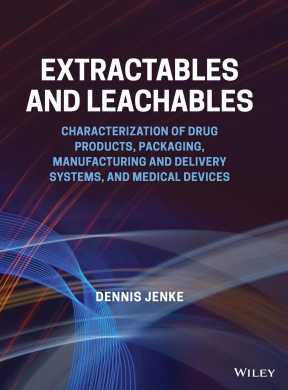
Description
Dennis Jenke, PhD, is the Chief Executive Scientist at Triad Scientific Solutions and has over 40 years of direct technical experience in the pharmaceutical, environmental, mining, geoscience, and chemical industries. Preface Acknowledgments 1. INTRODUCTION AND ESSENTIAL CONCEPTS 1.1 General Discussion 1.2 Regulations, Guidelines, Standards and Recommendations for Chemical Compatibility Assessments 1.3 Why Chemical Assessment? 1.4 An Overview of the Chemical Compatibility Assessments Process 1.5 Looking Ahead 1.6 References 2. GENERAL PRINCIPLES OF CHEMICAL ASSESSMENT; EXTRACTION AND LEACHING 2.1 Key Definitions and Concepts, Extractables and Leachables 2.2 Extraction Studies 2.2.1 Key Definitions and Concepts 2.2.2 Types of Extractions 2.2.3 Examples of Extraction Sequences 2.2.4 Required/Recommended Extractions 2.2.5 Principles of Extraction 2.2.5.1 Thermodynamics and Kinetics of Extraction and Leaching 2.2.5.2 Extraction Solvents, Polarity 2.2.5.3 Extraction Solvents, pH 2.2.5.4 Temperature/Duration 2.2.5.5 Stoichiometry 2.2.5.6 Additional Factors to Consider 2.2.6 Compromised Extracts 2.3. Leaching Studies 2.4 Variation in Extraction and Leaching Studies 2.5 References 3. GENERAL PRINCIPLES OF CHEMICAL ASSESSMENT; ANALYTICAL TESTING FOR EXTRACTABLES AND LEACHABLES; ORGANIC COMPOUNDS 3.1 Key Definitions and Concepts 3.2 Organic Substance Analysis, Screening 3.2.1 Relevant Analytical Methods 3.2.2 Survey of Chromatographic Screening Methods 3.2.3 Derivation and Use of the Analytical Evaluation Threshold (AET) 3.2.3.1 Definitions and Concepts 3.2.3.2 Sample AET Calculations 3.2.3.3 Uncertainty Adjustments to the AET 3.2.3.4 Selecting the Basis for the AET 3.2.3.5 The Relationship Between the AET and other Measures of Analytical Sensitivity 3.2.4 Discovery 3.2.5 Identification and Identification Categories 3.2.6 The Identification Process 3.2.7 “Quantitation” 3.2.8 Uncertainty Adjustments to Quantitative Data 3.2.9 Reducing Variation via Process Optimization 3.2.10 Screening Errors and their Mitigation – Extractables/Leachables Database 3.2.11 Method Qualification 3.3 Organic Substance Analysis, Targeting 3.3.1 Intent and Purpose 3.3.2 Selection and Justification of Targets 3.3.3 Establishing Reporting Practices 3.3.4 Method Validation 3.4 Organic Substance Analysis, Targeted Screening 3.5. Extractables/Leachables Correlations 3.5.1 Linking Extractables and Leachables 3.5.2 A Hierarchy for Linkages between Extractables and Leachables 3.5.3 Decisions Concerning the Required Rigor for Linkages 3.5.4 Circumstances Requiring the Linking of Extractables and Leachables 3.5.5 Examples of Linkages between Extractables and Leachables 3.5.6 Practical Realities Associated with Linking Extractables and Leachables 3.6 Intra-laboratory Variation in Extractables/Leachables Profiles 3.6.1 PQRI Controlled Extraction Study 3.6.2 Investigation of Lab-to-Lab Variation Between Four Testing Laboratories 3.6.3 Investigation of Extraction Conditions for Medical Devices 3.6.4 If You Play this Game Long Enough, You are Bound to Repeat Yourself 3.6.5 Addressing Variation in Environmental Testing 3.6.6 Concluding Thoughts 3.7 References 4. GENERAL PRINCIPLES OF CHEMICAL ASSESSMENT; ANALYTICAL TESTING FOR EXTRACTABLES AND LEACHABLES; ELEMENTS, ANIONS AND GENERAL TESTING 4.1 Elemental Analysis 4.1.1 The Mandate for Extractable Element Testing 4.1.2 Identifying Proper Articles for Extractable Elements Testing 4.1.3 Establishing Proper Test Parameters 4.1.3.1 Generating the Extract 4.1.3.2 Testing the Extract 4.1.4 Selecting Target Elements 4.1.5 Reporting and Interpreting Extracted Elements Test Results 4.1.6 Other Considerations 4.1.6.1 Extracted Elements and the Product Lifecycle 4.1.6.2 Global Standards for Extracted Elements Testing 4.1.6.3 Use and Value of Vendor-supplied Information 4.1.7 Existing Knowledge Concerning Extracted Elements in Materials and Systems 4.2 Ionic Extractables 4.3 Scouting via General Chemical Analysis 4.3.1 General Discussion 4.3.2 pH 4.3.3 UV Absorbance 4.3.4 TOC 4.3.4.1 Use of TOC in Screening 4.3.4.2 Performing a TOC Reconciliation 4.3.4.3 Using TOC Reconciliation to Judge the Completeness of Extractables Profiling 4.3.4.4 Using Unreconciled TOC to estimate the Level of Unknown Extractables 4.4 References 5. EXTRACTABLES, LEACHABLES AND THE PRODUCT LIFECYCLE THROUCH PRODUCT APPROVAL AND LAUNCH 5.1 Introduction 5.2 Situation 5.3 Definitions 5.4 The Chemical Compatibility Assessment Process 5.4.1 Material Selection 5.4.2 System Qualification 5.4.3 Product Qualification 5.4.4 Product Maintenance, Change Control 5.4.5 Component Testing 5.5 Elements of the Chemical Compatibility Assessment Process 4.5.1 Stage 1: Material Selection 5.5.1.1 General Discussion 5.5.1.2 Vendor Information 5.5.1.3 Material Assessment 5.5.1.4 The Material Characterization and Selection Report 5.5.2 Supporting Product Development Between Stages 1 and 2 5.5.2.1 Revision Control during Product Development 5.5.2.2 Supplemental Testing during Product Development 5.5.3 Stage 2: System Qualification 5.5.3.1 Discussion 5.5.3.2 The System Qualification process 5.5.3.3 Extractables Profiling 5.5.3.4 Impact Assessment of the Extractables Profile 5.5.3.5 The Analytical Evaluation Threshold (AET) 5.5.4 Stage 3: Product Qualification 5.5.4.1 Discussion 5.5.4.2 The Concept of Target Leachables 5.5.4.3 Product Qualification via a Targeted Migration Study Performed on Stability 5.5.4.4 Impact Assessment of Target Leachables 5.5.4.5 Leachables Screening 5.6 Advanced Topics in Chemical Compatibility Assessment 5.6.1 Application of Design Space Concepts to Chemical Compatibility Assessment 5.6.2 Migration Modelling to Reduce Study Duration 5.6.3 Extractables and Leachables Database to Facilitate the Transition from Scouting to Profiling 5.6.4 Regulatory Status 5.7 References 6. EXTRACTABLES, LEACHABLES AND THE PRODUCT LIFECYCLE, CHANGE CONTROL 6.1 Stage 4: Life Cycle Management; Change Control via a Comparability Protocol 6.1.1 A Tiered Approach to Change Control 6.1.2 Two levels of Change, T0 Assessment 5.1.2.1 Material Level Changes (Tier 0) 5.1.2.2 System Level Changes (Tier 0) 6.1.3 Tier 1 Assessment 6.1.4 Tier 2 Assessment 6.1.5 Additional Lifecycle Management Considerations 6.1.5.1 Refreshing a System’s Extractables Profile 6.1.5.2 Control of Incoming Materials 6.2. Stage 4: Life Cycle Management; Change Control via a Risk-based Approach 6.2.1 Discussion 6.2.2 Definitions 6.2.3 Essential Principles of Change Categorization 6.2.4 Understanding the Absolute Risk 6.2.5 Stage 1 Categorization; Use of Prior Knowledge to Drive Categorization 6.2.6 Stage 2 Categorization; General Process 6.2.6.1 Change Dimensions 6.2.6.2 Dimension #1, Where in the packaging system is the change being made? 6.2.6.3 Dimension #2, What type of change is being considered? 6.2.6.4 Dimension #3, How is the packaging system being changed? 6.2.6.5 Dimension #4, What is the magnitude of the change? 6.2.7 Completing Stage 2 Categorization 6.3 References 7. APPLICATIONS – PHARMACUETICAL DRUG PRODUCTS – PACKAGING 7.1 Classification of Packaging Systems and Components 7.2 Pharmacopeial Monographs 7.2.1 The Role of the Pharmacopeia in Setting Standards for Chemical Characterization of Packaging 7.2.2 Pharmacopeial Guidance; Compendial Monographs 7.2.3 The United States Pharmacopeia (USP) Monographs on Packaging Materials and Systems 7.2.3.1 General Discussion 7.2.3.2 Plastic Packaging Systems and Their Materials of Constructions; , , , 7.2.3.3 Plastic Packaging; Extractables and Leachables, and 7.2.3.4 Containers – Glass; and 7.2.3.5 Elastomeric Components; , 7.2.4 The European Pharmacopeia (Pharm Eur) Monographs on Packaging Materials and Systems 7.2.5 Other Pharamcopeia 7.3 Regulatory Guidance 7.3.1 The FDA 1999 Container Closure Guidance 7.3.2 The FDA Guidance for OIDNP 7.3.3 The EMEA Guideline on Plastic Immediate Packaging (2006) 7.4 Best Practice Recommendations 7.4.1 PQRI OINDP 7.4.2 PQRI PDP 7.4.3 PQRI POP 7.5 Risk Classification of Packaging Systems 7.6 Extractables Profiling of Packaging Systems based on Risk Classification 7.7 Case Studies 7.7.1 Injectable Drug Products 7.7.2 Other Dosage Forms 7.8 References 8. APPLICATIONS – PHARMACEUTICAL DRUG PRODUCTS – MANUFACTURING COMPONENTS AND SYSTEMS 8.1 Introduction 8.2 Industry Perspectives 8.2.1 Vendor Perspective, Bio-Process Systems Alliance (BPSA) 8.2.2 User Perspective, BioPhorum (BPOG) 8.2.2.1 General Discussion 8.2.2.2 Performing Extractions 8.2.2.3 Analysis of Extracts 8.2.2.4 Reporting Extractables Test Results 8.2.2.5 Leachables 8.3 Compendial Guidance, USP and 8.3.1 Perspectives on the Development of a USP Monograph for the Chemical Characterization of Pharmaceutical Plastics 8.3.2 Objectives and Scope 8.3.3 The Concept of a Comparator; Initial Assessment 8.3.4 Risk Assessment and Risk Classification 8.3.5 Risk-based Testing of Plastic Components and Systems 8.3.6 The Standard Extraction Protocol per USP 8.4 Flexibility in the Implementation of USP 8.5 Risk Classification of Manufacturing Components 8.5.1 General Requirements per USP 8.5.2 A Scientifically Rigorous Risk Assessment Process 8.5.3 The BioPhorum Leachables Risk Assessment Process 8.5.4 The USP Extractables Risk Assessment Process 8.6 Case Studies 8.7 References 9. APPLICATIONS – MEDICAL DEVICES 9.1 Introduction 9.2 Regulatory Landscape – ISO 10993; Extraction 9.2.1 ISO 10993:12(2012) 9.2.2 ISO 10993:20(2020) 9.2.3 Reconciling the Extraction Conditions Contained in Parts 12 and 18 9.3 Linking Extraction Conditions to Medical Device Categories 9.4 Regulatory Landscape – ISO 10993; Testing of Extracts 9.4.1 Test Methods 9.4.2 Test Method Qualification 9.4.3 Reporting of Test Data 9.5 The Chemical Characterization Process for Medical Devices per 10993:18(2020) 9.5.1 The Chemical Characterization Flow Chart 9.5.2 Compositional Assessment 9.5.3 Extractables Assessment 9.5.4 Leachables Assessment 9.6 FDA Recognition of Part 18 9.7 Medical Device Packaging 9.8 Case Studies 9.9 References 10. GENERAL PRINCIPLES FOR RISK ASSESSMENT OF EXTRACTABLES AND LEACHABLES 10.1 Toxicological Safety Risk Assessment of Extractables and Leachables 10.1.1 Introduction 10.1.2 Key Definitions and Concepts 10.1.3 The Toxicological Safety Risk Assessment Process Simplified 10.1.4 Toxicological Safety Risk Assessment of Pharmaceutical Packaging 10.1.5 Toxicological Safety Risk Assessment of Medical Devices 10.1.6 Toxicological Safety Risk Assessment of Manufacturing Components 10.1.7 Toxicological Safety Risk Assessment of Incompletely Identified Compounds 10.2 The Special Case of Biologics 10.3 Biological Safety Risk Assessment 10.3.1 Key Definitions and Concepts 10.3.2 Biological Tests and Test Methods 10.4 The Use of Auxiliary Information in Safety Risk Assessment 10.5 Are Organic Extractables and Leachables Inherently Unsafe? 10.6 Assessing Risks other than Patient Safety 10.7 References 11. FOCUS ON EMERGING CONCEPTS 11.1 A Dose of Reality 11.2 Designing and Implementing Better Extractions 11.3 Achieving Better Analytical Outcomes 11.3.1 Making the Case for Standardized Methods 11.3.2 Reducing, Mitigating and Eliminating Errors and Variation in E&L Testing 11.3.3 The Final Word on Setting the Uncertainty Factor, UF, for AET Adjustment 11.4 Information Sharing for the Common Good 11.5 Reduction of Redundant Testing 11.6 Replacing the Lab with a Computer (Mathematical Modeling) 11.6 Consider the Impact of a Result Before Attempting to Improve It 11.7 The End of E&L? 11.8 References 12. GLOSSARY AND ABBREVIATIONS APPENDIX: Principles for Identifying Organic Extractables and Leachables A.1 Identification Classes, Processes and Practices A.1.1 Introduction A.1.2 Identification A.1.3 Identifying Information and Its Use A.1.3.1 Mass Spectral matching A.1.3.2 Manual Mass Spectral Interpretation – Structural Elucidation A.1.3.3 Additional Evidences – Securing the Identity with the Highest Confidence A.1.4 Practical Considerations in Identification A.2 Identification via Mass Spectral Matching A.2.1 Introduction to Mass Spectral Matching A.2.2 Relevance of External Mass Spectral Libraries for Identification A.2.3 Detection and Discrimination of Analyte Signals (Spectra) for Identification A.2.4 Evaluation of Mass Spectral Matching Results A.2.5 Examples of Identification by Mass Spectral Matching A.2.5.1 Example 1: Correct Identification for Best Hit (MF > 900); GC/MS A.2.5.2 Example 2: Correct identification for Best Hit (800 A.2.5.3 Example 3: Incorrect identification for Best Hit (800 A.2.5.4 Example 4: False Positive Identification for Best Hit (700 A.2.6 Closing Comments A.3 Identification by Mass Spectral Interpretation A.3.1 Introduction to Mass Spectral Interpretation A.3.2 Identification of the Molecular Formula A.3.3 Interpretation of Isotopic Data A.3.4 Interpretation of Mass Fragments: De Novo Structural Elucidation A.3.5 Case Studies A.3.5.1 Case 1: Molecular Ion Not Identified A.3.5.2 Case 2: Molecular Ion is Identified (unit mass) A.3.5.3 Case 3: Molecular Formula is Identified (accurate mass) A.3.6 Conclusion A.4 Additional Evidences – Securing the Identity with the Highest Confidence A.4.1 Retention Time/Index Matching A.4.2 Tandem Mass Spectrometry A.4.3 Additional Evidences from Orthogonal Techniques A.4.4 Derivatization A.4.5 Indirect Inferences A.4.6 The Use of a Database to Capture the Identification Efforts A.4.7 Conclusion A.5 Overall Conclusion A.6 References