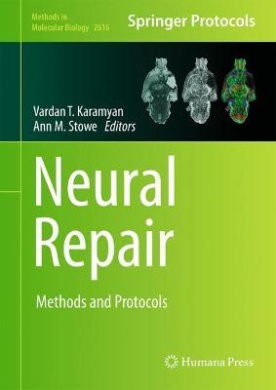
Description
Part I: Stroke Models and Surgical Interventions 1. Rodent Stroke Models to Study Functional Recovery and Neural Repair Daimen R.S. Britsch, Nausheen Syeara, Ann M. Stowe, and Vardan T. Karamyan 2. Subcortical White Matter Stroke in the Mouse: Inducing Injury and Tracking Cellular Proliferation Miguel Alejandro Marin, Amy J. Gleichman, Andrew J. Brumm, and S. Thomas Carmichael 3. A Low Budget Photothrombotic Rodent Stroke Model Faisal F. Alamri, Serob T. Karamyan, and Vardan T. Karamyan 4. Photothrombotic Model to Create an Infarct in the Hippocampus Elena Blanco-Surez 5. Bilateral Carotid Artery Stenosis and Cerebral Blood Flow Outcomes Ifechukwude Joachim Biose and Gregory Jaye Bix 6. Internal Carotid Artery Stenosis: A Surgical Mouse Model to Study Moyamoya Syndrome Jill M. Roberts and Justin F. Fraser 7. Modeling Distal Middle Cerebral Artery Occlusion in Neonatal Rodents with Magnetic Nanoparticles or Magnetized Red Blood Cells Jie-Min Jia and Yuxiao Jin Part II: In Vivo and Post-Mortem Imaging of Mechanisms of Recovery 8. In Vivo Imaging of the Structural Plasticity of Cortical Neurons after Stroke Emilia Conti, Francesco Saverio Pavone, and Anna Letizia Allegra Mascaro 9. Measurement of Uninterrupted Cerebral Blood Flow by Laser Speckle Contrast Imaging (LSCI) during the Mouse Middle Cerebral Artery Occlusion Model by an Inverted LSCI Setup Sung-Ha Hong, Andrea Doan, and Sean P. Marrelli 10. Multi-Exposure Speckle Imaging for Quantitative Evaluation of Cortical Blood Flow Adam Santorelli, Colin T. Sullender, and Andrew K. Dunn 11. Wide-Field Optical Imaging in Mouse Models of Ischemic Stroke Jonah A. Padawer-Curry, Ryan M. Bowen, Anmol Jarang, Xiaodan Wang, Jin-Moo Lee, and Adam Q. Bauer 12. Post-Mortem Magnetic Resonance Imaging of Degenerating and Reorganizing White Matter in Post-Stroke Rodent Brain Vera H. Wielenga, Rick M. Dijkhuizen, and Annette Van der Toorn Part III: Methods to Identify Molecular and Immune Mechanisms Supporting Recovery 13. Quantitative Spatial Mapping of Axons across Cortical Regions to Assess Axonal Sprouting after Stroke Mary T. Joy, Samuel P. Bridges, and S. Thomas Carmichael 14. Quantitative Evaluation of Cerebral Microhemorrhages in the Mouse Brain Rudy Chang and Rachita K. Sumbria 15. In Vivo Evaluation of BBB Integrity in the Post-Stroke Brain Yong Zhang, Saeideh Nozohouri, and Thomas J. Abbruscato 16. High Resolution RNA Sequencing from PFA-Fixed Microscopy Sections Hao Ji, Simon Besson-Girard, Peter Androvic, Buket Bulut, Lu Liu, Yijing Wang, and Ozgun Gokce 17. FACS to Identify Immune Subsets in Mouse Brain and Spleen Mary K. Malone, Thomas A. Ujas, Katherine M. Cotter, Daimen Britsch, Jenny Lutshumba, Jadwiga-Turchan-Cholewo, and Ann M. Stowe 18. A Guide on Analyzing Flow Cytometry Data Using Clustering Methods and Non-Linear Dimensionality Reduction (tSNE or UMAP) Thomas A. Ujas, Veronica Obregon-Perko, and Ann M. Stowe 19. Co-Culturing Immune Cells and Mouse-Derived Mixed Cortical Cultures with Oxygen-Glucose Deprivation to In Vitro Simulate Neuroinflammatory Interactions after Stroke Thomas A. Ujas, Vanessa O. Torres, and Ann M. Stowe Part IV: Behavioral Methods for Quantifying Functional Recovery 20. Assessing Depression and Cognitive Impairment Following Stroke and Neurotrauma: Behavioral Methods for Quantifying Impairment and Functional Recovery Karienn A. de Souza, Michelle Hook, and Farida Sohrabji 21. Use of an Automated Mouse Touchscreen Platform for Quantification of Cognitive Deficits after Central Nervous System Injury Katherine M. Cotter, Grace L. Bancroft, Harley A. Haas, Raymon Shi, Andrew N. Clarkson, Matthew E. Croxall, Ann M. Stowe, Sanghee Yun, and Amelia J. Eisch 22. Using Operant Reach Chambers to Assess Mouse Skilled Forelimb Use after Stroke Dene M. Betz, April M. Becker, Katherine M. Cotter, Andrew M. Sloan, Ann M. Stowe, and Mark P. Goldberg 23. The Finer Aspects of Grid-Walking and Cylinder Tests for Experimental Stroke Recovery Studies in Mice Nausheen Syeara, Sounak Bagchi, Abdullah Al Shoyaib, Serob T. Karamyan, Faisal F. Alamri, and Vardan T. Karamyan 24. Performing Enriched Environment Studies to Improve Functional Recovery Daniela Talhada and Karsten Ruscher Part V: Neurotherapeutics and Functional Recovery 25. Clinically-Applicable Experimental Design and Considerations for Stroke Recovery Preclinical Studies Vardan T. Karamyan 26. Hydrogels and Nanoscaffolds for Long-Term Intraparenchymal Therapeutic Delivery after Stroke Mozammel H. Bhuiyan, Josh Houlton, and Andrew N. Clarkson 27. Reverse Translation to Develop Post-Stroke Therapeutic Interventions during Mechanical Thrombectomy: Lessons from the BACTRAC Trial Benton Maglinger, Jacqueline A. Frank, Justin F. Fraser, and Keith R. Pennypacker 28. Methods to Study Drug Uptake at the Blood-Brain Barrier Following Experimental Ischemic Stroke: In Vitro and In Vivo Approaches Robert D. Betterton, Erica I. Williams, Kelsy L. Nilles, Thomas P. Davis, and Patrick T. Ronaldson 29. Gene Silencing in the Brain with siRNA to Promote Long-Term Post-Stroke Recovery Bharath Chelluboina and Raghu Vemuganti Part VI: Models of Comorbidities 30. Diabetic Rodent Models for Chronic Stroke Studies Lea Julie Dalco and Kunjan R. Dave 31. Use of Conventional Cigarette Smoking and E-Cigarette Vaping for Experimental Stroke Studies in Mice Salvatore Mancuso, Aditya Bhalerao, and Luca Cucullo 32. Middle Cerebral Artery Occlusion in Aged Animal Model Grant W. Goodman, Justin N. Nguyen, Frank W. Blixt, Michael E. Maniskas, Louise D. McCullough, and Anjali Chauhan 33. Acute Ischemic Stroke by Middle Cerebral Artery Occlusion in Rat Models of Diabetes: Importance of Pre-Op and Post-Op Care, Severity of Hyperglycemia, and Sex Weiguo Li, Yasir Abdul, and Adviye Ergul 34. The DOCA-Salt Model of Hypertension for Studies of Cerebrovascular Function, Stroke, and Brain Health T. Michael De Silva and Frank M. Faraci