Description
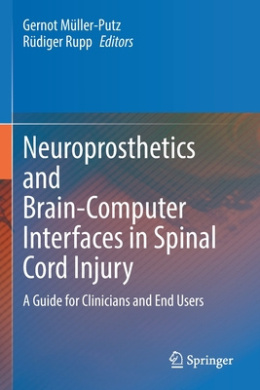
This book provides a comprehensive overview of the current state of the art of practical applications of neuroprosthesis based on functional electrical stimulation for restoration of motor functions lost by spinal cord injury and discusses the use of brain-computer interfaces for their control. The book covers numerous topics starting with basics about spinal cord injury, electrical stimulation, electrical brain signals and brain-computer interfaces. It continues with an overview of neuroprosthetic solutions for different purposes and non-invasive and invasive brain-computer interface implementations and presents clinical use cases and practical applications of BCIs. Finally, the authors give an outlook on cutting edge research with a high potential for clinical translation in the near future. All authors committed themselves to use easy-to-understand language and to avoid very specific information, focusing instead on the essential aspects. This makes this book an ideal choice not only for researchers and clinicians at all stages of their education interested in the topic of brain-computer interface-controlled neuroprostheses, but also for end users and their caregivers who want to inform themselves about the current technological possibilities to improve paralyzed motor functions. Part I – Basics Chapter 1 – Spinal Cord injury Chapter 2 – Functional Electrical Stimulation Chapter 3 – Electroencephalography and Brain-Computer Interfaces Part II – Neuroprosthetics in SCI Chapter 4 – History of Neuroprosthetics Chapter 5 – Upper Extremity Neuroprosthetics for Spinal Cord Injury Chapter 6 – Neuro-Robotics: Rehabilitation and Restoration of Walking using Exoskeletons via Noninvasive Brain Machine Interfaces Chaoter 7 – Epidural and transcutaneous spinal cord stimulation strategies for motor recovery after spinal cord injury Part III – Clinical Brain Computer Interfaces Chapter 8 – P300 BCI for persons with spinal cord injury – a BCI search of an application? Chapter 9 – Invasive BCI approaches for restoration of upper extremity movements Chapter 10 – Towards non-invasive BCIs based for movement decoding Part IV – Clinical use cases and practice Chapter 11 – Therapeutic applications of Electrical Stimulation in Spinal Cord Injury Chapter 12 – Brain Computer Interface Controlled Functional Electrical Stimulation for Rehabilitation of Hand Function in People with Spinal Cord Injury Chapter 13 – Non-invasive Brain-Computer Interfaces for control of grasp neuroprosthesis – The European MoreGrasp Initiative Part V – Outlook Chapter 14 – Therapies of the future