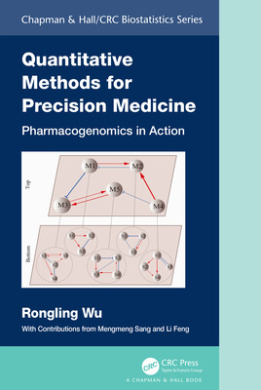
Description
1. Methodological Foundation of Precision Medicine. 1.1. Interpersonal variability in drug response. 1.2. Mechanistic modelling of drug response. 1.3 Statistical models for mapping drug response. 1.4 Network mapping of drug response. 1.5 Conclusions and Outlook. Part I: PharmacokineticPharmacodynamic Pharmacogenetics. 2. Pharmacogenetic Dissection by Functional Mapping. 2.1. Introduction. 2.2. Quantitative Genetics. 2.3. A General Framework for Functional Mapping. 2.4 Pharmacogenetic Application of Functional Mapping. 2.5. High-dimensional Functional Mapping. 2.6. Concluding Remarks. 3. A Multiscale Model of Pharmacokinetic-Pharmacodynamic Mapping. 3.3. Heterochronopharmacodynamic Mapping. 3.4. Mapping Multifaceted Drug Reactions. 3.5. Concluding Remarks. 4. Pharmacogenetic Mapping of Missing Longitudinal Data. 4.1 Introduction. 4.2. Strategies for Modeling Non-Ignorable Dropout Data. 4.3. Haplotyping Drug Response Using the Pattern-Mixture Model. 4.4. Haplotyping Drug Response Using the Selection Model. 4.5. Concluding Remarks. 5. Systems Mapping of Drug Response. 5.1. Introduction. 5.2. ODE Modeling of PK/PD Machineries. 5.3. Systems Mapping: Model and Algorithm. 5.4. Stochastic Systems Mapping. 5.5. Concluding Remarks. Part II. Network Pharmacogenetics. 6. Network Mapping of Drug Response. 6.1. Introduction. 6.2. Functional Graph Theory. 6.3. Functional Pharmacogenetic Interaction Networks: An Example. 6.4. Fine-Grained Dissection of Pharmacogenetic Networks. 6.5. Modularity Theory and Dunbars law. 6.6. Concluding Remarks. 7. Learning Individualized Pharmacogenetic Networks. 7.1. Introduction. 7.2. A Framework for Network Inference. 7.3. Coalescing Individualized Networks into Stratification-Specific Networks. 7.4. Computer Simulation. 7.5. Reconstructing Multilayer Genetic Networks. 7.6. Concluding Remarks. 8. A Game-Theoretic Model of Cell Crosstalk in Drug Response. 8.1. Introduction. 8.2. GameTalker: A crosstalk model of tumor-microenvironment interactions. 8.3. Modeling Personalized Cell-Cell Interaction Networks. 8.4. Reconstructing multilayer gene regulatory networks of tumor-TME interactions. 8.5. Predictive network model for cancer growth. 8.6 Concluding Remarks. 9. A Graph Model of Personalized Drug-Drug Interactions. 9.1. Introduction. 9.2. Inferring DDI networks. 9.3. Inferring dynamic DDI networks from static data. 9.4. Coalescing high-order DDIs into hypernetworks. 9.5. Learning Large-scale DDI Networks. 9.6. Concluding remarks. 10. Pharmacogenomics as a Cornerstone of Precision Medicine: Methodological Leveraging. 10.1. Introduction. 10.2. How Drug Works. 10.3. Correcting for Relatedness in Pharmacogenomics GWAS. 10.4 Family-based Designs for PGx Studies. 10.5. Intertwined Epistatic and Epistatic Networks. 10.6. Pharmacosystems Biology: from Pharmacogenomics to Pharmaco-Omics. 10.7. Concluding Remarks.