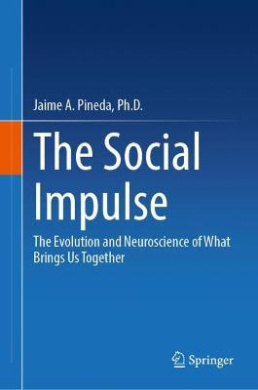
Description
During 36 years at the University of California, San Diego, Jaime A. Pineda received his Ph.D. in Neuroscience, completed postdoctoral work in Psychiatry, and was founding faculty member of the Cognitive Science Department. Until his retirement in 2018, Professor Pineda directed the Cognitive Neuroscience Laboratory where he explored the relationship between mind and brain. His research focused on the neuroetiology of autism, the role of mirror neurons in social cognition, neuronal plasticity, and brain-computer interfaces. He served on many NIH committees and was a reviewer for several scholarly journals. He is the author of over 100 articles, books, and reviews on the relationship between brain and mind, having published many widely cited papers in animal and human cognitive and systems neuroscience. Professor Pineda used brain imaging techniques, as well as behavioral, psychological and pharmacological methods, to understand normal and abnormal cognitive function. As a principal investigator on a long-term project studying Autism Spectrum Disorder, he was interested in developing strategies to reduce cognitive, behavioral, and neurofunctional deficits through self-directed neural plasticity. Professor Pineda was also scientific co-founder of Otosound, a biomedical therapeutics company involved in the treatment of tinnitus, and an active advisor for a variety of neurotechnology companies. Professor Pineda came to the United States from Honduras, Central America in 1963 at 9 years of age to get a better education. He is also a writer and poet, focusing on mind-brain relationships with an emphasis on spirituality, mysticism, environmentalism, and social activism. Table of Contents Part I Differentiation-Integration Dynamics: Ultimate Causes Chapter 1: Introduction 1.1 Darwinian Dilemmas 1.2 Lingering Issues in the Social Domain 1.3 Goals and Themes Chapter 2: Purposeless Design 2.1 System of Synthetic Philosophy 2.2 The Supreme Law of Every Becoming 2.3 Revolutionary Ideas 2.4 Social Evolution Chapter 3: Darwinian Evolutionary Theory 3.1 The Incompleteness of Natural Selection 3.2 Group or Multilevel Selection 3.3 Gene-Culture Coevolution in Humans 3.4 Lamarckian Evolution and Epigenetics 3.5 Filling in a Darwinian Gap Chapter 4: Principles of Differentiation and Integration 4.1 Integrating the Processes of Evolution 4.2 Fundamental, Opposing Forces 4.3 Decreased Interdependency, Increased Complexity 4.4 Decreased Autonomy, Increased Function 4.5 Integration and Differentiation in the Brain Chapter 5: The Information Trend in Science 5.1 Evolution as Information 5.2 Features of Scientific Integration 5.3 Vertical Integration of Information 5.4 Horizontal Integration Chapter 6: Is Social Cohesion a Different Mechanism of Evolution? 6.1 Not Parallel, but Interactive and Intentional 6.2 Cultural Innovations as Traits 6.3 Cumulative Culture, Groups, and Social Cohesion 6.4 The Role of Communication 6.5 Sociocultural Primitives and Self-Organization Part II Roots and Mechanisms: Proximate Causes Chapter 7: Fundamental Physical Forces, Genes, and Epigenetics 7.1 Entropy and Negentropy in Evolution 7.2 Eusociality and Prosociality Responses to Evolutionary Pressures 7.3 Genetic Transition to Eusociality and Prosociality 7.4 The Impact of Epigenetics on Sociality Chapter 8: Biological Origins 8.1 From Unicellular to Multicellular Life 8.2 Cell Signaling and Adhesion 8.3 Phylogenetic Continuity 8.4 Mathematical Aggregation and Cohesiveness Chapter 9: Neural Mechanisms of Sociality 9.1 The Social Brain 9.2 Phylogeny of Social Behavior 9.3 Group Dynamics and Knowledge of Others 9.4 Social Intersubjectivity and the Insular Cortex 9.5 Interpersonal Neurobiology Chapter 10: Psychological Features 10.1The Cognitivism Paradigm 10.2Psychological Mechanisms of Social Cognition 10.3The Role of Imitation Learning 10.4Evolutionary Psychology, Memes, and Culture Chapter 11: Cognitive Science Underpinnings 11.1Social Cognition and Cohesiveness 11.2Empathy and Compassion 11.3Phylogenetic Primitives and Ontogenetic Continuity 11.4Constraints on the Becoming Function 11.5Phenomenology: The Lived Experience Chapter 12: A Sociological Systems Theory 12.1Societal Differentiations 12.2Structurally Linked Sociality and Social Cohesion 12.3Social Enactivism and Collective Rituals in the Wild Chapter 13: Developmental Roots 13.1Developmental Evolutionary Psychology 13.2History of Cognitive Development 13.3Social Brain Networks 13.4The Importance of Language 13.5Architecture of the Linguistic Systems Chapter 14: Metaphysical, Religious, and Spiritual Aspects 14.1Metaphysics and Religious Transformation of Reality 14.2The Importance of Myths: A Story of Origins 14.3Integration as the Search for Unity 14.4Evolution and Democratization of the Religious Impulse 14.5Cultural Aspects of Religion Part III Survival Value Chapter 15: Sociality’s Survival Value 15.1Filling in the Explanatory Gaps 15.2Benefits of a More Synthetic Theory 15.3Wise Managers of Evolutionary Processes 15.4Social Cohesion and Sociality 15.5Why Males Court and Females Choose 15.6Doing and Undoing Complexity 15.7Emergent General Intelligence Part IV Conclusions Chapter 16: A New Framework: A Theory of Integration 16.1Refinement of the Darwinian Framework 16.2Sociality as Constraint-Satisfaction and Self-Organizing 16.3Origins of Social Cohesion 16.4Sociocultural Development of Sociality 16.5Final Thoughts Appendix Poem: Song of the Shattering Vessels References Index