Description
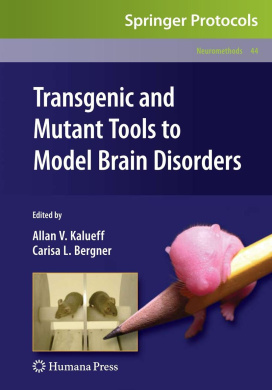
As the presence of genetically modified animal models in research laboratories has multiplied, the role of genetic factors in the pathogenesis of brain disorders has become particularly important. The refinement of molecular genetic methods has continued to broaden our understanding of the genetic factors associated with a variety of disorders. In “Transgenic and Mutant Tools to Model Brain Disorders”, leading scientists specializing in this field contribute a timely collection of recent advances featuring a vast array of topics in order to contribute to the diverse approaches taken toward the evaluation of genetically modified models in biomedical research. Opening with several chapters covering general aspects of genetically modified animal models, the book then continues with detailed chapters on models of specific human brain disorders, including OCD, Rett Syndrome, anxiety disorders, depression, and schizophrenia. As a volume in the successful Neuromethods(TM) series, the chapters provide authoritative reviews covering the most commonly used approaches in the field. Cutting-edge and concise, “Transgenic and Mutant Tools to Model Brain Disorders” offers a comprehensive and descriptive overview on a variety of topics in neuroscience and biological psychiatry. Part I: General Approaches 1. Mutant and Transgenic Zebrafish in Modeling Neurobehavioral Disorders Carisa L. Bergner, Rupert J. Egan, Peter C. Hart, Jonathan M. Cachat, Peter R. Canavello, and Allan V. Kalueff 2. Knockout and Mutant Rats Mareike Mller, Jocelien Olivier, and Judith Homberg 3. Rat Mutants with Lateralized Rotational Behavior for Studying Disturbances in Cerebral Asymmetries and Their Involvement in Brain Disorders Wolfgang Lscher 4. GABAA Receptor a1 Subunit (Gabra1) Knockout Mice: Review and New Results Gui-Lan Ye, Kevin B. Baker, Sara M. Mason, Wandong Zhang, Laura Kirkpatrick, Thomas H. Lanthorn, and Katerina V. Savelieva 5. Basal Ganglia Disorders in Genetic Models and Experimentally-Induced Lesions Robert Lalonde and Catherine Strazielle 6. Estrogen Deficient Mouse Models in the Study of Brain Injury and Disease Rachel A. Hill and Wah Chin Boon Part II: Specific Brain Disorders 7. The Utility of Genetically Modified Animals in Modeling OCD-Spectrum Disorders Amanda N. Smolinsky, Carisa L. Bergner, Peter C. Hart, Rupert J. Egan, Brett D. Dufour, Justin L. LaPorte, and Allan V. Kalueff 8. Investigating Rett Syndrome through Genetic Mouse Models: Pre-Symptomatic, Clearly Symptomatic Phases, and Innovative Therapeutic Approaches Bianca De Filippis, Laura Ricceri, and Giovanni Laviola 9. Genetic Animal Models of Anxiety Rupert J. Egan, Carisa L. Bergner, Peter C. Hart, Justin L. LaPorte, and Allan V. Kalueff 10. Genetic Animal Models of Depression Peter R. Canavello, Rupert J. Egan, Carisa L. Bergner, Peter C. Hart, Jonathan M. Cachat, and Allan V. Kalueff 11. Environmental Enrichment and Gene-Environment Interactions in Mouse Models of BrainDisorders Anthony J. Hannan 12. Mutant and Transgenic Tools in Modeling Schizophrenia Lieve Desbonnet, Katsunori Tomiyama, Noriaki Koshikawa, Colm M. P. O’Tuathaigh, and John L. Waddington